
Blog 87 - Another moment when the theatre reminds me why it has always been my life.
This piece of writing is revised and updated from the November 16 entry in my book, Theatre Is My Life!
In “My Favorite Things” from The Sound of Music, Maria and the Mother Abbess (in the Broadway version), or Maria alone (in the film), sing about their dearest items. Because I can’t quote song lyrics, I hope you will listen to the work online (YouTube has a video clip of the movie) or from your library!
The Sound of Music has music by Richard Rodgers, lyrics by Oscar Hammerstein II, and a book by Howard Lindsay and Russel Crouse, based on the memoir of Maria von Trapp, The Story of the Trapp Family Singers
It is 30 days till Christmas, and the holiday tunes have already been booming in stores and restaurants for weeks and weeks. One of those seasonal staples, of course, is “My Favorite Things.” Long before it became a commercialized holiday hit, Rodgers and Hammerstein wrote it to push back the dark.
In the original Broadway version, which opened 67 years ago this month, Maria and the Mother Abbess sing the song together in the office as Maria prepares to leave the security of the convent. It’s really just a checklist of small joys to drown out the fear of the unknown—a reminder of what keeps us steady.
Right now, my own list of dearest items would include my sweet Apple Watch tracking my steps, a small piece of fresh perfectly fried chicken, the azure ceramic lamp in my bedroom that used to be my grandmother’s, the medieval tapestries on my walls snagged at several Liberty of London’s after-Christmas sales, the amazing Pocketful of Miracles daybook by Joan Borysenko, my electric heating pad, a Bear Bryant Roll Tide frosted candle holder, my morning routine, an aromatic cup of French Press coffee, Mozart or Beatle music, tiny violets growing in my green grass. I could go on and on. Oh, and my life in the theatre, of course.
Theatre requires a strange kind of faith. We spend weeks making something that will evaporate almost as soon as it is finished—building sets to be dismantled, sewing costumes to be stored away, and releasing words into the darkness that vanish the moment they are spoken. And perhaps that is one of the gifts theatre has given me: learning to love something wholeheartedly, even knowing it won't last.
Still, it leaves its mark. For instance, I treasure the memory of my daughter Elin helping fabricate costumes—many, many nuns’ habits—for her high school’s production of The Sound of Music during her sophomore year. She was too busy singing in four choirs to be in the production, but she would come home and croon all the tunes from the show, until the play closed and she moved on to other treasured melodies.
There’s a spiritual lesson in the theatrical “strike,” that bittersweet ritual of tearing down a world you spent months building. It usually comes immediately after the final curtain falls. During most of my academic career at Samford University, I co-designed a lot of the scenery as well as the costumes. Some of those sets were so lovely, I wept to see them torn down. Because the costume crew was able to pack the clothing away rather quickly (and without ripping pieces apart!), I volunteered to be the runner to pick up pizza for the after-party. Then, I wouldn’t have to watch that last bit of life we had built crumble into bits of rubble.
Looking back, strike was an early brush with impermanence. We unscrew the platforms, pack away the costumes and the props, sweep up the sawdust, and suddenly the stage is just a blank, empty space again.
I wish I could say that a lifetime in the theatre taught me not to mourn the bare stage. But clearly, it took me a while. Even now, I sometimes feel melancholy when I think about all those favorite settings: those beautiful worlds we constructed and then demolished.
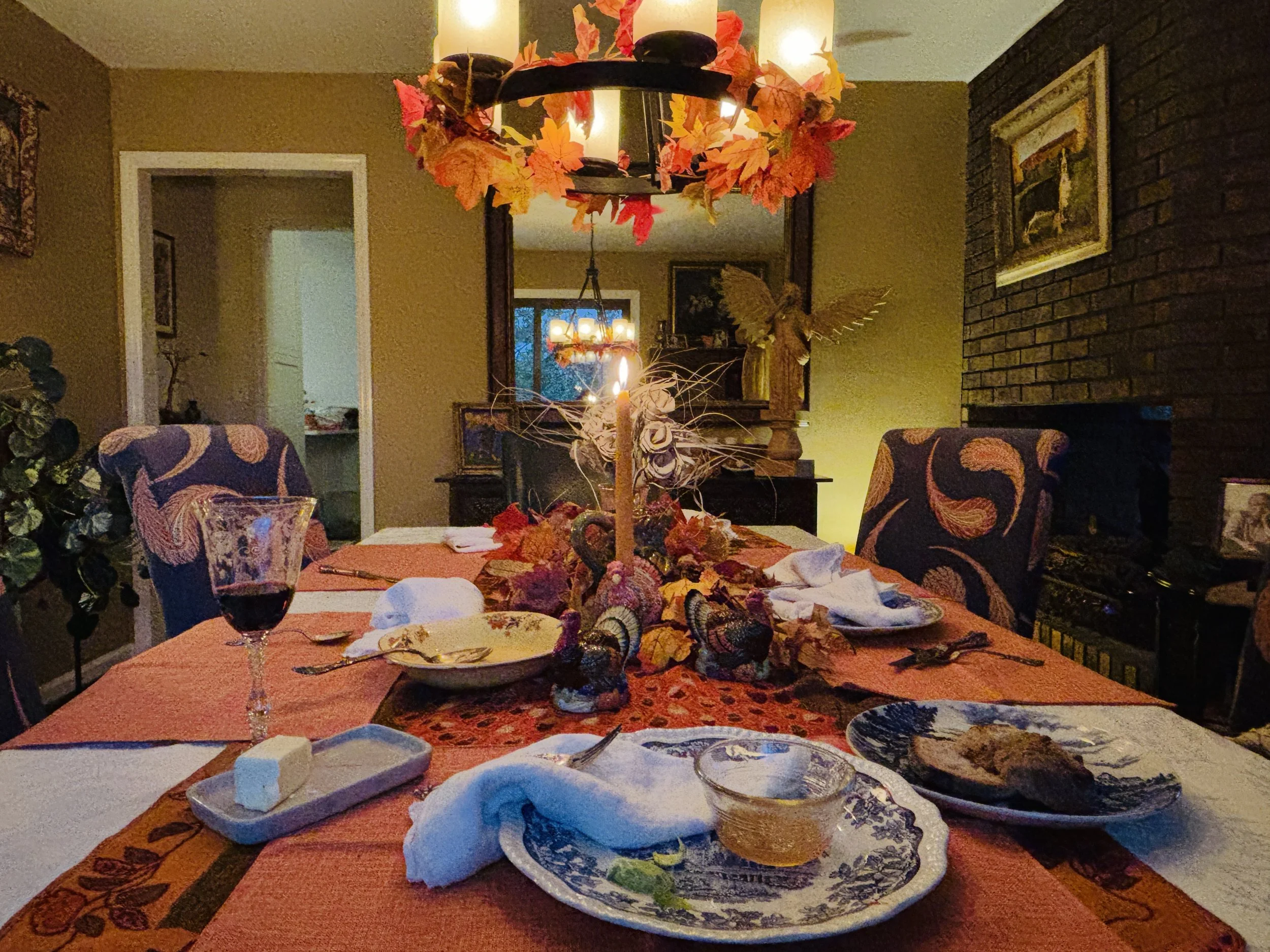
As we approach Thanksgiving, I realize the holiday table operates on much the same leap of faith. After days of grocery shopping, chopping, roasting, and decorating, the celebration seems to be over in minutes. The feast we labor over disappears, leaving behind a clean table, a stack of dishes, and a quiet house. Some of us may even shed a few tears over the fleeting nature of such holidays.
But this Thanksgiving, I am thinking differently. When the crowd leaves and the table is empty, I hope to feel gratitude for the day precisely because it couldn't last forever. There will still be the good dishes, the silverware, the turkey salt and pepper shakers, and perhaps some leftovers. Like a treasured costume discovered years later on a storage rack, these ordinary, beloved belongings will remind me of the people who gathered around the table and the pleasure of having been together.
And perhaps that is what Maria and the Abbess were singing about all along. It’s more than just a catalog of best-loved items; it’s about the memories and experiences that make those items dear to us. Remembering them gives us courage to face what lies ahead.
My theatrical memories have helped shape how I live, long after the productions have closed and the scenery has been carted away. And I suspect this Thanksgiving gathering, fleeting as it will be, will become another memory that sustains me.
How about you? What are some of your favorite things that won't last forever? Will you always be grateful they happened?