
For One Season in Their Very Long Lives
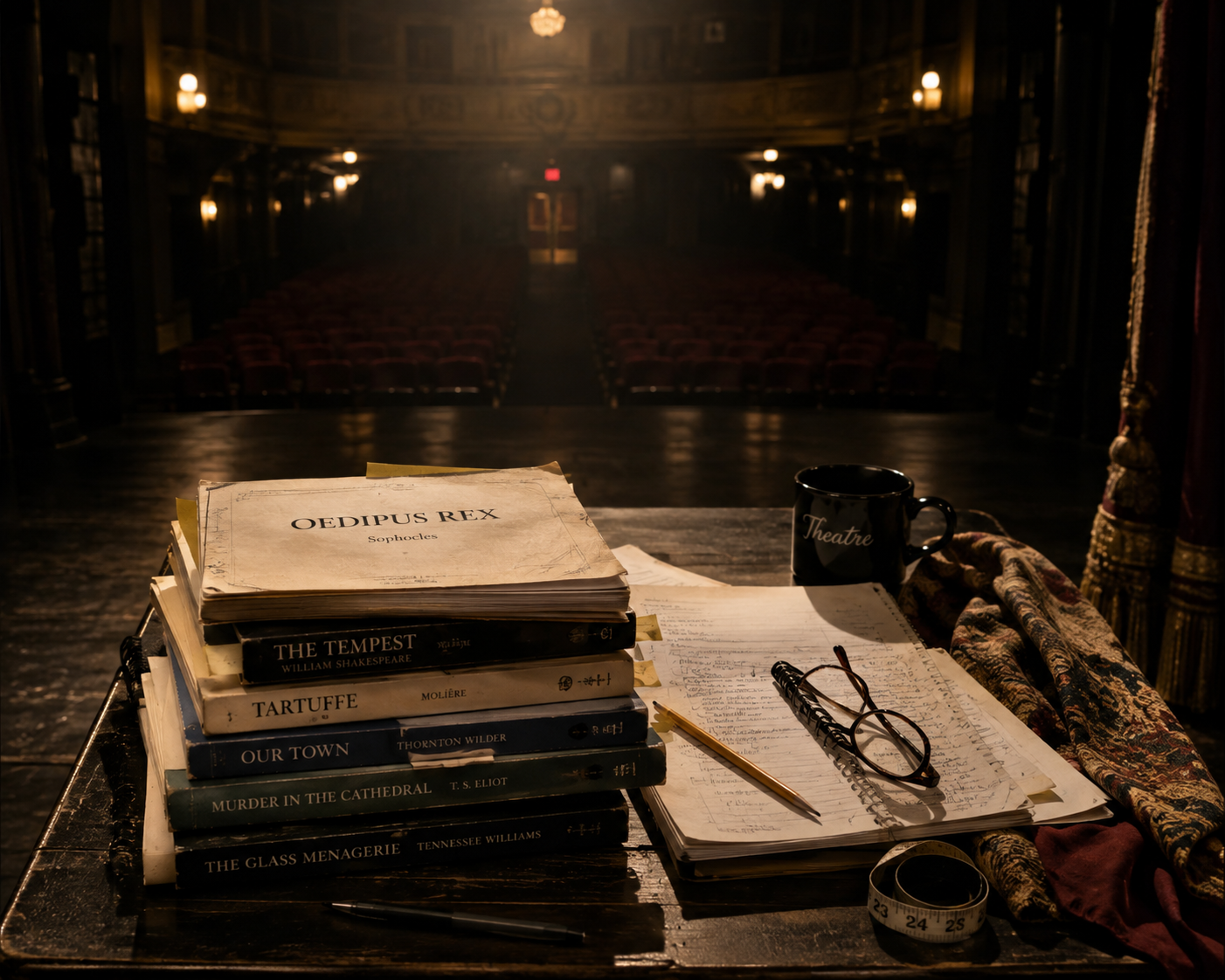
The Astonishing Privilege of Bringing Great Plays to Life
Blog 80 - Another moment when the theatre reminds me why it has always been my life.
Many of my blogs come from my book, Theatre Is My Life, but this is a new one inspired by a recent rumination about my life in the theatre.
“Our revels now are ended. These our actors, as I foretold you, were all spirits and are melted into air, into thin air... We are such stuff as dreams are made on.”
Prospero in William Shakespeare’s The Tempest, Act IV, Scene 1
“We are such stuff as dreams are made on,” Shakespeare once wrote. Looking back at the incredible productions I have had the privilege to work on, those words have never felt truer. There are moments in the theatre when I have looked around a rehearsal space and suddenly thought, “How on earth did I get here?”
Not because I doubted myself. But working in the theatre gives me a profound sense of awe—a feeling of “what magical force pulled me into this?” that leaves me deeply honored.
Just the other day, a thought struck me. I have been allowed to bring to life the words on a page written by immortal playwrights. At different times in my life I have been the director or the designer who matched my wits with Sophocles. William Shakespeare. Molière. Carlo Goldoni. Thornton Wilder. Archibald MacLeish. T. S. Eliot. Tennessee Williams…
Their ageless, enduring plays have survived changes in time, culture, and fashion. These visionary writers created incandescent vessels that have floated from the stages of their day to the rehearsal halls of ours.
And I think that working in academic theatre, teaching students how to study a play, then memorize its words, then embody them, and finally deliver them was electrifying! I remember my Samford students, as Chorus members, delivering lines like “Yet we have gone on living, Living and partly living” from T.S. Eliot’s Murder in the Cathedral.
Unlike the sage elders they portrayed, the students who wailed and lamented Eliot passages were full of the vigor and promise of youth. And yet, they inhabited these chorus parts. They devoured the text and spit out lines about “our hearts are torn from us, our brains unskinned like the layers of an onion, our selves are lost, lost” and being “afraid in a fear which we cannot know, which we cannot face, which none understands.” Confronted, in delivering the words of this play, with the perplexities of life, these students grappled with—at a young age—the challenge of making sense of it all: the meaning of who we are, and the reason for our being on earth.
Such experiences remind me why theatre can be a spiritual space, a place where we cross a line into the Holy and can no longer continue the “constant evasion of ourselves." There is something almost liturgical about the process.
And it happens over and over and over: when an actor suddenly grasps the comedic timing of Molière or Goldoni, when a tech crew begins to whisper the lines of Oedipus as it is being rehearsed, when an entire cast weeps at the delivery of Wilder’s line “Do any human beings ever realize life while they live it?—every, every minute?”
As I work on a play, and dig deep into the text, I realize profoundly that every generation is only borrowing these plays for a little while before handing them on to the next. Theatre is unlike a painting hanging in a museum. The Parthenon doesn't have to be rebuilt every night for us to experience it. Oedipus does. Emily's realization in Our Town disappears into the air after it is spoken. Tomorrow night, an actor has to deliver it again.
Every production begins at zero. Someone has to find a text that resonates personally, and then dig deep into it to reclaim it. Someone has to envision the setting. Someone has to walk in the shoes of every character to design the costumes. Someone has to learn and then speak those lines again. Someone has to trust that audiences in Birmingham, Provincetown, London, or a small college theatre still have ears capable of hearing them.
And for a season of my life… that someone happened to be me. It is extraordinary, because theatre was not my original passion in life. I wanted to be a journalist and a studio artist. Early in my freshman year at the University of Montevallo, I slipped in the back door of Palmer Hall one dark evening. Several of my friends were rehearsing a play on stage, and one of them invited me to visit. It was early in the process of producing the musical Of Thee I Sing.
I sat alone in the darkened audience chamber, with work lights brightening the stage, and watched the fascinating character, W.T. Chichester, the director, explain where to move, how to say a line, and when to react to another actor. He rolled a cigarette between the fingers and thumb of his left hand the entire time, ashes dripping on the floor. The place smelled like a mix of old wood, faint velvet, and a hint of cold iron. Dust gathered in the tight corners and beneath the seats, as it always seemed to in Palmer.
Before my eyes in this one brief hour or two, a miraculous thing happened: a show began to take shape. Confidence grew, lines stabilized, blocking crystallized: it began to look like a scene from a play! Joe, Frank, and Susan were no longer the friends I knew, but characters inhabiting another life.
From then on, every time the house lights dimmed, I knew something remarkable was about to happen. Whether I ran the spotlight, directed the play, or designed and built the costumes, words written centuries ago would once again breathe. Actors would lend their bodies to ideas larger than themselves. An audience would gather in the dark, willing to believe. And somehow, I had been invited to help make this miracle happen one more time.
I wrote a book and entitled it Theatre Is My Life! Why has theatre been my life?
Not because I love costumes. Not because I love directing. Not even because I love Shakespeare. But because, over and over, I've had the astonishing privilege of becoming one link in a chain stretching back more than two thousand years.
I don't own the plays with which I have been entrusted. For a little while, I cared for them. I studied them, questioned them, dressed them, gave them rooms to inhabit, and helped actors find their way into their words. Then an audience gathered in the dark, the words lived again, and eventually, as Shakespeare knew they would, our revels ended.
The scenery came down. The costumes went back onto their racks. The actors moved on. The productions themselves melted into air. But the plays did not.
The plays waited for the next company, the next director, the next actor encountering those words for the first time.
For one season in their very long lives, these plays passed through my hands. What an astonishing privilege that has been.