
When the Queen of the Night Comes Calling
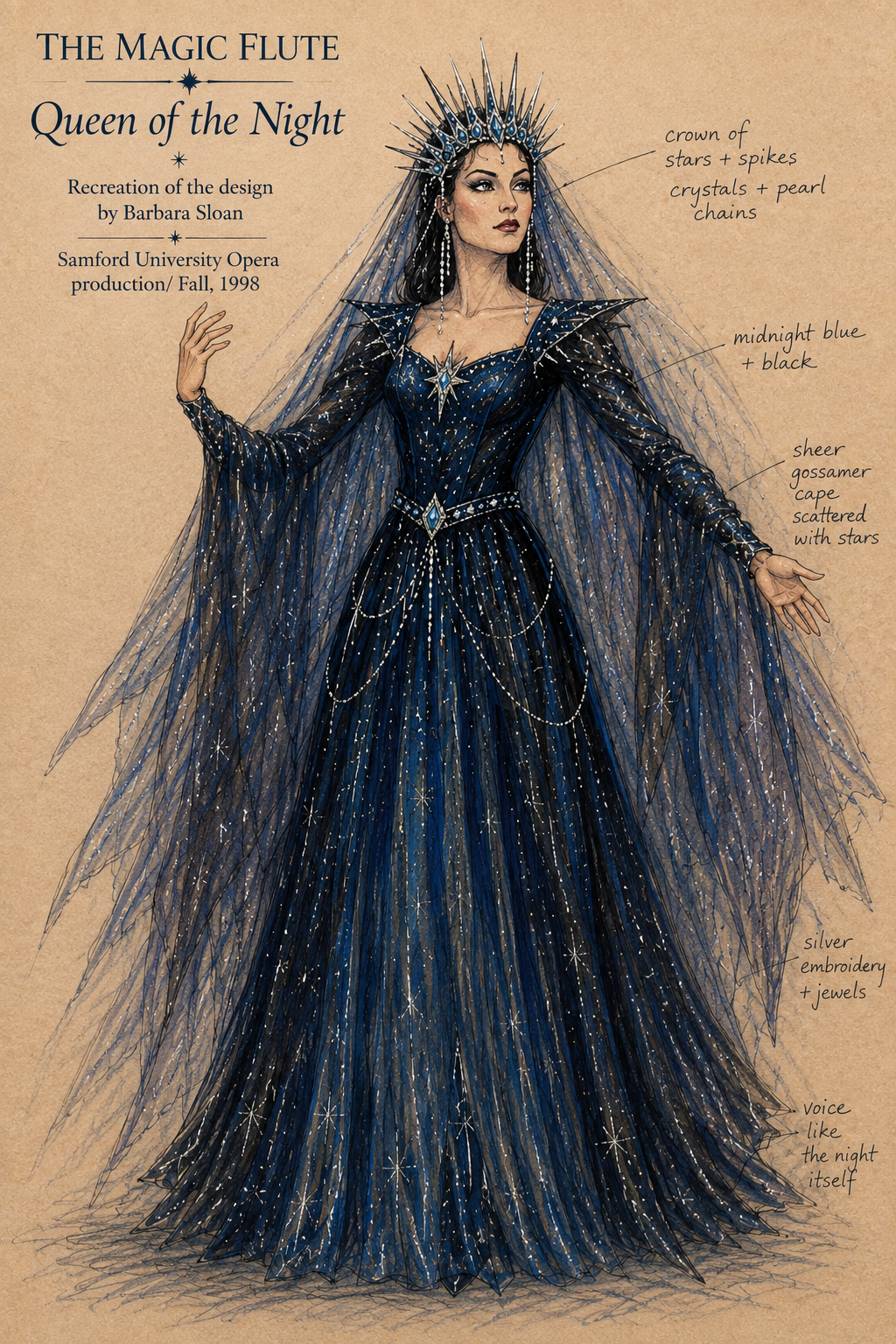
My design for The Queen of the Night
Blog 81 - Another moment when the theatre reminds me why it has always been my life.
Like some of my blogs, this piece of writing comes from my book, Theatre Is My Life for August 25, but this is a new interpretation of my original writing!
Mozart, Sleepless Nights, and the Questions We Ask in the Dark
August 25
“The sun, the splendid herald of the morn,
will soon set off upon his golden course –
soon will doubts disappear,
soon the wise man will triumph! –
O sweet contentment, descend upon us,
return to human hearts;
then earth shall be a paradise
and mortals be like Gods.”
The Boys in Wolfgang Mozart’s The Magic Flute
Designing the costumes for Samford University Opera’s 1998 production of Mozart’s final masterpiece, The Magic Flute, was unbridled joy—partly because the plot is absolutely bananas. It starts as a classic fairy tale: a handsome prince (Tamino), a captured princess (Pamina), and a magic flute. And their sidekick is a carefree, food-loving bird catcher, Papageno, who has a set of magic bells. He might have been my favorite character to costume, as we covered his tunic with feathery crescents of thin, plumage-like fabrics.
And then, of course, the pivotal character of the opera is the grand, imposing Queen of the Night. She sends the prince to rescue her daughter from a supposedly evil sorcerer.
Then comes a massive plot twist: the supposedly ‘evil’ sorcerer is actually the good guy, protecting the princess from her totally unhinged mother. The Queen eventually storms the stage in a fit of rage, commanding her daughter to commit murder. She sings one of opera’s most famous arias, hitting notes so high you have to weep at their beauty despite her character flaws.
Designing the Queen’s costume involved capturing that volatile energy. I wanted her outfit to exude "cosmic dictator with an inkling of overbearing stage mom." Her grand plan to rule the world fails, and she is banished into the dark. But that piercing, haunting voice stays with you—not unlike the spinning thoughts that torment many of us during a bad bout of insomnia.
Ah, me, that mad, shadowy thing called a “sleepless night” must truly be ruled over by this wicked Queen. She haunts me every few months, or even weeks, and it happened just the other evening. When I first wrote about the Queen of the Night in 2014, I had recently discovered that two friends and I shared another acquaintance with her realm: sleepless nights.
All three of us confessed to being plagued by mysterious doubts and curious uncertainties during our nightly agonizing tossing and turning. In 2014, I said that sleeplessness made sense when I “had” to worry about teenagers spending the night out, making soccer teams, driving, dating, getting into college — or during family deaths, tornadoes, national crises.
Sleeplessness even made sense during menopause, when I was a furnace blazing all night long. But beneath those more understandable worries was something deeper: I fretted over my life's import. I felt worthless, as if I had heretofore had a meaningless and futile existence. The more I talked to myself about how wrong that was, how beautiful life is, how much the Divine shows up every day, the more useless and hollow everything seemed.
Presently, I realize that when the house is dark and quiet, my mind stops looking outward and starts looking inward. Middle-of-the-night worry is often a deeply philosophical event rather than just a physical problem. At three in the morning, the barrier between my busy daily life and the deeper mysteries of existence can feel very thin. Daytime distractions disappear. Old regrets and choices echo more loudly in the dark, asking for forgiveness or acceptance, and even the ultimate mystery of what comes next can feel as dark as the room itself.
Those thoughts in the early hours aren't necessarily false. Some of the questions may be real: Has my life mattered? Have I used it well? What am I leaving behind? Those aren't foolish questions. Perhaps the mistake is trying to judge the meaning of an entire life from the middle of one dark scene. The distortion is that darkness convinces us there is only one possible answer. Daylight doesn't answer the question. It enlarges the world in which we're asking it.
I think I understand why human beings have always personified darkness, fear, and evil—the Queen of the Night, Satan, Voldemort. In the depths of those midnight trials, I can feel as if I am being overtaken by someone else's thoughts, someone who certainly does not have my well-being uppermost on her agenda.
But perhaps I understand something else now that I didn't when I first wrote these words. The doubts that come in the darkness do not necessarily disappear because we have finally argued them into submission. Morning simply restores perspective. The room has not changed. My life has not changed. But light has entered it again.
And perhaps that is why The Magic Flute still speaks to me. Tamino and Pamina do not escape their trials. They walk through them, accompanied by music, until they emerge into light.
I have begun to think that much of life works that way. We are not promised freedom from the dark places. We are given things that help us travel through them: people we love, faith, beauty, laughter, memory, and, for me, again and again, the theatre.
The Queen of the Night gets the spectacular aria. She gets the rage, the impossible high notes, and for a while she gets the whole stage.
But she does not get the last word.
The sun does.