
Something Left to Love
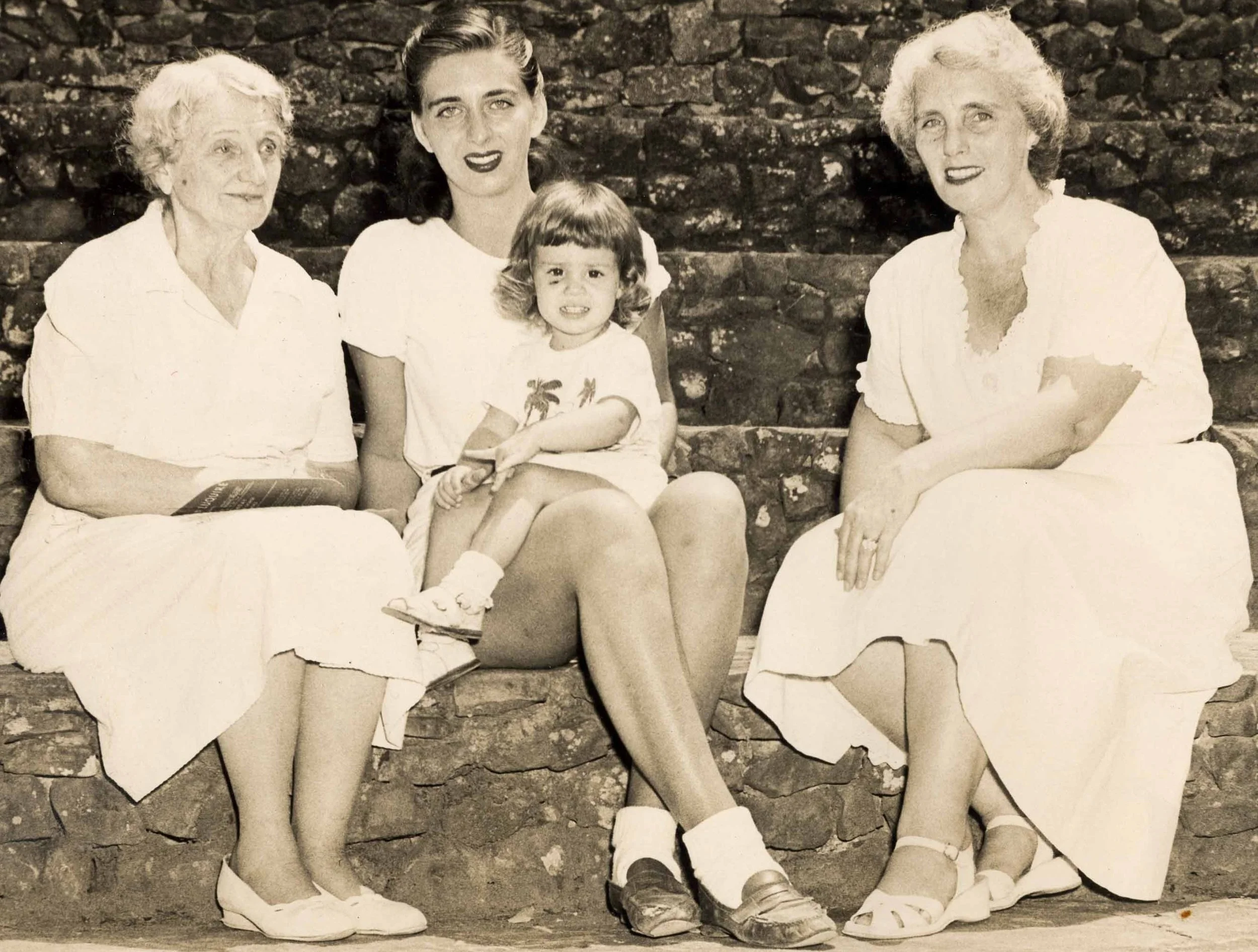
Four Generations: Nannie, Babaw, My Mother, and Me
Blog 83 - Another moment when the theatre reminds me why it has always been my life.
Growing Up Between Two Houses and Two Ways of Loving
This piece of writing is new, though you can read other meditations based on play quotes in my book Theatre Is My Life.
"There's always something left to love. And if you ain't learned that, you ain't learned nothing."
Mama in Lorraine Hansberry’s A Raisin in the Sun
Tomorrow would be my mom’s 98th birthday, and I still miss her everyday. I keep coming back to Lorraine Hansberry’s words—that “there's always something left to love”—when I think about my mother and grandmother. For them, loving people was a deep feeling—but it was also something they chose to do every day, even when things were hard.
Now that they're gone, I realize that the love they left behind didn't disappear. It's still here, built into the tiny habits I picked up from them, funny thoughts they shared, sad tears we shed, and the quiet moments when I suddenly miss them the most.
I was the first grandchild, and between my childhood home and my grandmother’s house next door lay a poignant contrast, a duality in how I learned to love and be loved.
My mother often said, even when I was very young, that I was more a mother to her than she was to me. Being called a "mother" to your own mother at age three meant I sometimes had to step into the role of a three-foot tall adult. I had to be the emotionally perceptive, caretaking anchor, and looking back, that was some task for a tiny child.
Family therapists have a cold, clinical term for this: “parentification.” And while the word describes the need for a child to parent a parent, it doesn't fit the warmth and passion of my relationship with my mother. Her reliance on me came from a place of vulnerability, not a lack of love.
With my dad away in Newfoundland for the Korean War, my very young mother was without the person who ordinarily steadied her. And somehow, impossibly, some of that need for reassurance fell upon little me.
Next door, in Babaw’s home, I was allowed to just be. As her first grandchild, I was the tended toddler, enveloped in a space where the heavy mantle of responsibility was lifted, and I was purely the recipient of a grandmother's devoted care, assisted by her entourage.
That house was a sanctuary of five women—full of female mojo—Babaw, my great-grandmother Nannie, and my three unmarried aunts, Patsy, Marge, and Jackie. And for the first five years of my life, I was their collective heartbeat.
In my own home, I observed my mother’s moods, anticipated her needs, and gave her advice. But in the other house close by, everyone was watching me just to see if I would smile or pout—or they were coaxing a poem or recitation of the alphabet from me. I remember the shifting sounds of that house: the quiet, steady presence of Nannie, sitting in her chair as a queen on the throne, quietly smiling, and observing the life and excitement of the younger generation.
Her tranquility was abruptly juxtaposed with the bright energy and laughter of my aunts getting ready for dates or coming home from work or school, busy, in and out, with a constant bevy of friends. There was always someone to pick me up, someone to tell me a story, and someone to make sure I was fed and safe. In that house, I didn't have to manage anyone else’s world; they built a gentle, protective universe entirely around me.
Unlike some grandmothers, Babaw was not an exceptional cook. Her food was good, but when I would run over to her house early in the day, I would encounter her morning ritual: burning the first batch of toast. Because she took care of her mother and was a single parent to the remaining three girls, I suppose she simply got preoccupied with getting all of them ready for school and work. And still, I remember the crispy smell distinctly and its accompanying scrape, scrape, scrape over the trash can to save as much as she could.
And I loved to watch her sew. When the Depression had descended, she, who was a meticulous and talented seamstress, began to make extra money stitching tutus and ballet costumes for Miss Lum’s Dance Studio. Then, in 1942, her husband Jack died of pneumonia in New York City. My grandmother had to travel up and then bring his body back on the train, and was left a youngish widow with four girls sixteen and under—so she sewed more and more to make ends meet.
One of my earliest memories is walking through the door one morning to discover a magical path through dozens of pale-toned tutus scattered across the floor. Ready to be tried on and adjusted for a recital, they were on every inch of floor and piece of furniture: pale yellow, carnation, lavender, pastel blue. It looked like an enchanted indoor garden with huge blossoms swirling through every downstairs room.
Eventually, though, the music in that house began to change. As Helen Macdonald wrote: “You see that life will become a thing made of holes. Absences. Losses. Things that were there and are no longer... you have to grow around and between the gaps.”
One of those holes for me was the moment we moved away from that house. Two of my aunts had married, and the other one was a busy high school student. I now had a baby brother and my mom and dad decided we needed more room.
“Absences. Losses. Things that were there and are no longer.” As we moved to one, then a second, then third and fourth subsequent house, my life was no longer filled with the daily trips to that home that hummed next door. I had spent so much of my earliest life in the company of adults that children my own age sometimes seemed almost foreign to me. So I had to grow around and between the gaps, and Mom did, too, as our lives moved on.
My mother’s anxieties were right there on the surface, and her fears were simply part of our everyday life. She was terrified of things she couldn't control—like sudden lightning storms or driving over long bridges. When we hit a bridge, we had a whole routine: my dad would have her get down on the floorboards of the car with her crocheting so she wouldn't see how high up we were, and he’d steer us across.
She looked to him as her absolute rock and protector. Yet, the same woman who couldn't face a thunderstorm was the driving force behind our entire extended family. She was the one who called everyone, stayed in touch with distant cousins, and organized many family get-togethers. She couldn't handle a bridge, but she knew exactly how to keep a massive family connected.
She also knew how to make a home where everyone was welcomed. As I became a teenager, Mom was the “cool mama” of the neighborhood; everyone gathered at our house to hang out and listen to rock and roll records. When my two best friends and I picked John, Paul, and George as “our Beatles,” my mother happily claimed Ringo, taking us to their movies over and over again.
Later, she became a local fashion model, letting me roam backstage to watch the frantic costume changes. I could write a whole piece on her colorfully off-color expressions, or the way she could stand on her head up through her seventies, her interesting posture while working crossword puzzles, or purse that smelled like tobacco and Doublemint gum.
Through every stage of my life, she was fiercely supportive of my brother and me. She held us through the times I changed churches, the little car wrecks, the monumental heartbreaks, and the rejections. Whenever something went wrong, she made vegetable soup to warm our bodies, hearts, minds, and souls.
Mom was there to celebrate the joys, too—my wedding, my theatre career, my awards, and my lasting friendships. She and my dad eventually became extraordinary grandparents to my daughter Elin and my son Seth, securely upholding me through a horrendous divorce and successive job changes.
Together, we both grew around and between those gaps that appear in life. Just today, I ate from one of the purple plates that were the last birthday gift Mom ever gave me. Even through the fog of dementia, she somehow managed to order a set of dishes from a paper catalog, knowing how much I loved them and choosing my absolute favorite color.
Tomorrow would be her ninety-eighth birthday. And I know I will put my hand out again toward the place where she was, where they all were: my mother, my grandmother, my great-grandmother, my aunts, that house next door, the burned toast, the laughter, the pale tutus scattered like blossoms across the floor.
They are gone. But the love isn’t. Hansberry’s Mama was right. “There's always something left to love.”