
Caw! Caw! Caw! A Blackbird, a Birthday, and a Bit of Synchronicity
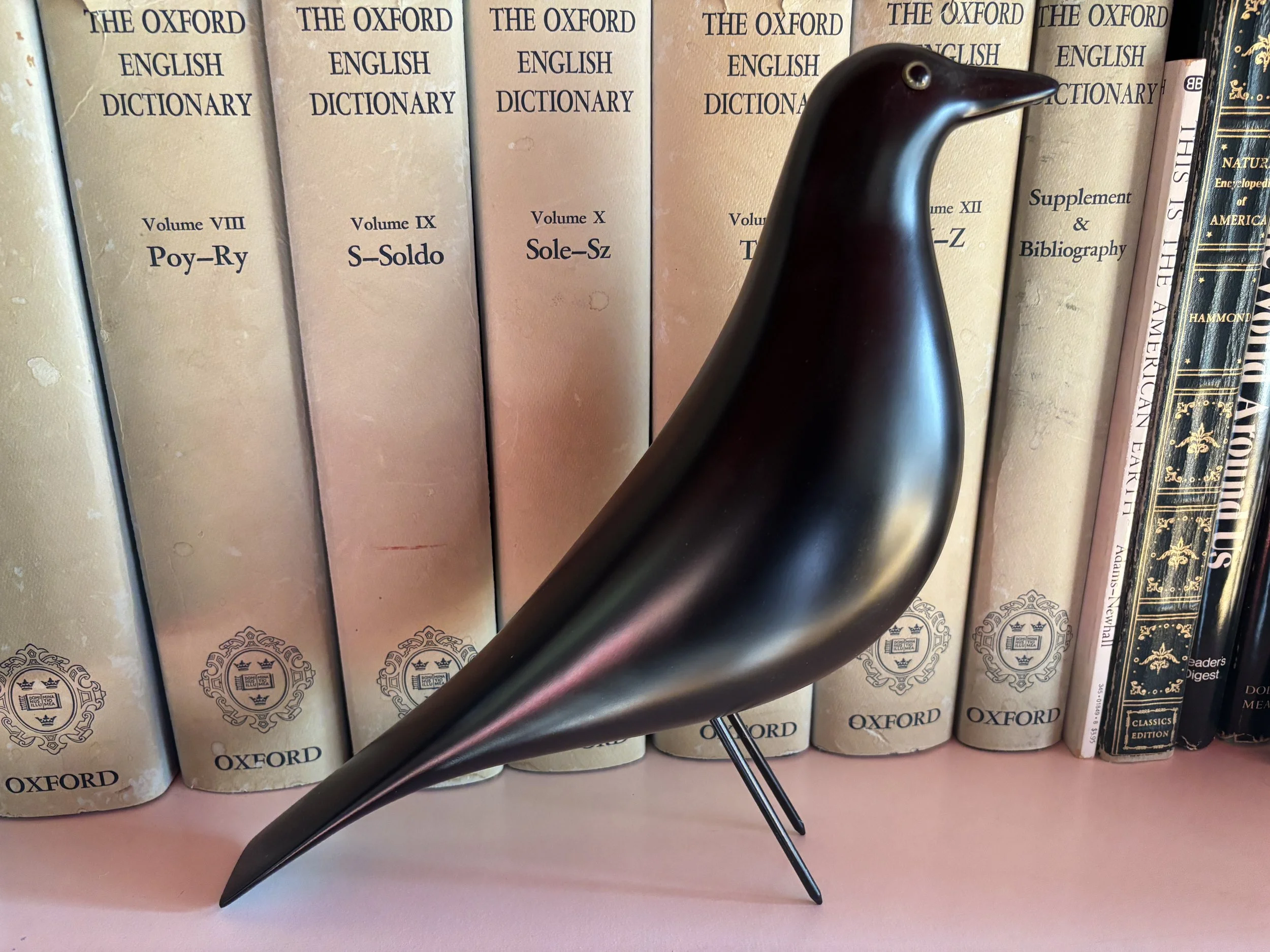
The Eames House Bird, a birthday gift from my friend Joe Taylor, still keeping watch over my words.
Blog 84 - Another moment when the theatre reminds me why it has always been my life.
Like some of my blogs, this piece of writing comes from my book, Theatre Is My Life. I have added some edits to it to reflect a decade of thought!September 29
“Tiécelin: Caw! Caw! Caw!
Brun: Stop that infernal racket!
Tiécelin: Caw! Caw!”
Tiécelin the Crow and Brun the Bear in Arthur Fauquez’s Reynard the Fox
We produced Arthur Fauquez’s charming Reynard the Fox when I was in college at the University of Montevallo. The play, a satire populated by a delightfully unruly assortment of talking animals, included a bear, a wolf, a marmot, a lion, a porcupine, and, of course, the fox. But my particular favorite was Tiécelin the Crow, played by my friend Drucilla.
All these years later, Drucilla still accompanies me on my early morning walks.
Well, not Drucilla herself, but Tiécelin. Well, not Tiécelin herself, but crows. My neighborhood is full of these black beauties, and scarcely a morning passes without one of them calling out, “Caw! Caw! Caw!”
“Stop that infernal racket!” I call back. They pay absolutely no attention to me.
Down the hill from my house is a roost where hundreds gather, circle, and settle for the night. It is quite a spectacle.
Crows are among the most intelligent birds on earth, but mine seem entirely uninterested in civilized conversation. Sometimes they rattle, click, or gronk, but I usually only hear their “Caw! Caw! Caw!” And every time I pass one of them on my morning walk, I find myself back in that college production, exchanging lines with a bird who has never once attended a rehearsal.
I have also long been fascinated by the ravens of the Tower of London. Though ravens and crows are different birds, they belong to the same genus, Corvus, and share a certain dark magnificence.
According to legend, if the ravens ever leave the Tower, the Crown and Britain will fall. At least six are traditionally kept there, with additional birds in reserve. Their flight feathers are carefully trimmed to discourage their departure. And so, if you believe in such lore, England’s fate rests upon a few noisy black ravens.
Shakespeare might have made something of that. And now comes the part that still makes me smile.
As I was writing this very piece for my Theatre Is My Life! book several years ago, the doorbell rang. The UPS delivery man had brought a late birthday present from my dear friend Joe Taylor, who lives near Washington, D.C.
I opened the brown package. And, if you can believe it, inside was a magnificent black Eames House Bird!
There I sat, writing about crows and ravens, just as an elegant black bird with a pointed beak and graceful tail arrived unannounced at my front door. And I am not making this up! The universe has a strange way of staging such incidents in my life.
The Eames House Bird became famous in the 1950s when designers Charles and Ray Eames included it in photographs of their furniture. The original, a piece of American folk art dating from around 1910, had been acquired during their travels. Today, reproductions of the sleek wooden bird remain popular design objects.
But mine was more than a handsome piece of sculpture. It had arrived at precisely the right moment.
The Swiss psychologist Carl Jung coined the term synchronicity to describe meaningful coincidences, events that seem connected even when there is no apparent causal relationship. I have always been intrigued by the idea.
Perhaps the arrival of my blackbird was nothing more than serendipity. Perhaps Joe simply has impeccable timing—he always has. Or perhaps there are connections in this extraordinary world that we do not yet understand. I don't particularly need to settle the question.
What I do know is that a crow in a college production has followed me through the years, calling from the trees on my morning walks, reminding me of a friend and a play I loved. And then, one afternoon, while I was writing about his colleagues, another black bird appeared at my door.
That Eames black bird still lives in my house, a reminder of Joe's friendship and one of the most curious afternoons of my writing life. Every time I look at it, I remember Drucilla, Tiécelin, the Tower ravens, and the noisy congregation down the hill. It is remarkable how much of life can gather around one small object.
The theatre has taught me to pay attention to such moments. Sometimes an old character returns when we least expect it. Sometimes an ordinary afternoon becomes a scene worth remembering. And sometimes, if we are fortunate, life delivers its own perfectly timed entrance.
Caw! Caw! Caw!