
The Haunting of Theatre Past
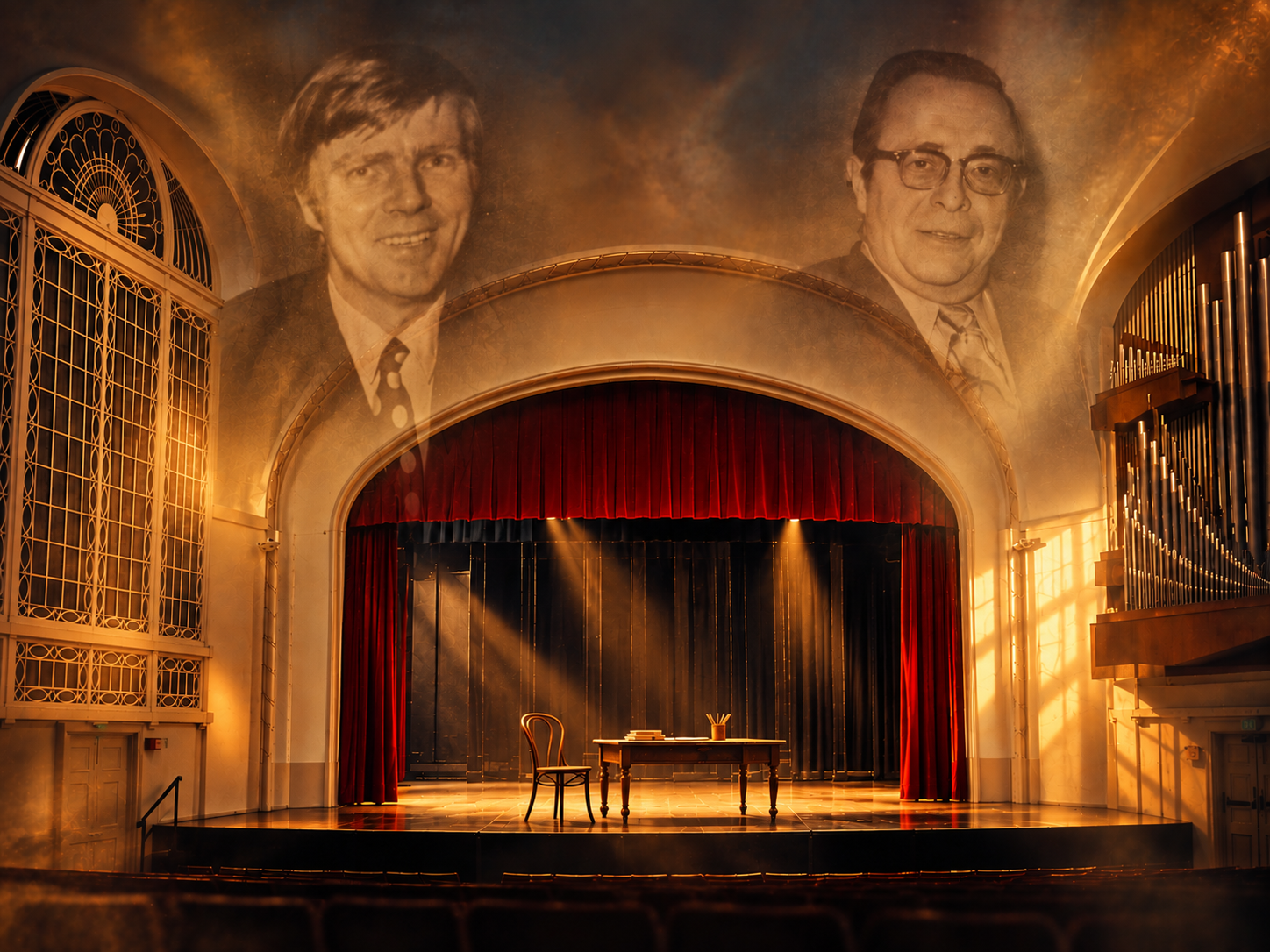
Blog 85 - Another moment when the theatre reminds me why it has always been my life.
This piece of writing is brand new, though many of my blogs come from my book, Theatre Is My Life.
October 13
“These our actors,
As I foretold you, were all spirits and
Are melted into air, into thin air.”
Prospero, in William Shakespeare’s The Tempest, Act IV, Scene 1
I believe the melancholy stirring within me right now comes from this transitional time in late September and early October. Golden light streams through leaves of fading green-yellow. The wind ruffles them and promises cooler weather ahead. It is a fluid spell, a thin place of seasons rather than geography; a time when schools are settling into a rhythm, and theatres are rehearsing and presenting their first plays.
I slip back through this liminal space to my college days. And there, I catch sounds I will never hear in a theatre again. One is the rattling of radiators along the back wall and in the dressing rooms: old iron beasts hissing and clanking during rehearsals, oblivious to whatever tragedy or comedy is unfolding onstage.
In the scene shop, I detect the swish-swish of Mr. WT Chichester, flogging the loose charcoal dust—and his own cigarette ashes—off the muslin backdrop stretched out on the floor. The “flogger" is not for recalcitrant student workers, but a stick with long strips of canvas stapled to it, and it erases lines no longer needed on the drop. We had already “sized” the fabric to shrink it taut and seal the pores, brooming a hot mixture of animal hide glue and whiting across the muslin.
Oh, and I smell that animal glue now, cooking in a makeshift double boiler: a large #10 tomato can sitting in a pot of water on a hot plate. That was also what we mixed with dry pigments to make scene paint. We could always tell when the paint was getting too old: it started smelling like rotting meat, animal proteins spoiling right there in the bucket, and we had to make a new batch.
Mr. Chi was a teacher who carried old theatre practices from the first half of the twentieth century right into our scene shop. Before coming to Montevallo, his life had already wound through New York radio and theatre, university stages, and even wartime entertainment.
During World War II, he was a soldier who was pulled right out of the ranks because his theatrical talent was too good to waste, and he was put to work directing entertainment for the troops. In the 1950s and ‘60s, many theatre departments were anchored by these larger-than-life, fiercely dedicated figures who brought a bit of old-school Broadway and showbiz dramatic flair to college campuses. And he certainly did that at Montevallo.
I vividly remember a chastisement he gave me while I was running the carbon-arc spotlight in the balcony for Show Boat. One night before rehearsal, our Joe (stevedore on the boat) was warming up, running through his “Ole Man River” with the orchestra. He had a towel around his neck to mop up sweat, and I thought this would be a perfect time to test different-colored gels to discover what effects I could create with the spotlight. I tried rose pink, I tried bastard amber, straw, special lavender, and blue.
To my horror, at just that moment the curmudgeonly Chichester strolled in and yelled up at me, “Baaa-bra! Get that dreadful blue light off that stage. Don’t you know that blue is a hideous color for a Black actor?!?!”
I certainly hadn't known what Mr. Chi thought about blue light on Black skin, but I never forgot the lesson—or the thunderous way it was delivered. Joe, thinking he might get chided for the towel draping his shoulders, quickly threw it into the wings.
“Keep that towel!” Mr. Chi roared. “It gives you charisma.”
From Chichester I learned the physical life of the theatre. From another professor, Dr. Charles Harbour, I absorbed its artistic and intellectual inheritance. He was well-read and sophisticated, but also warm, direct, and charming.
If Mr. Chi was the raw, beating heart of our productions—all sweat, canvas, and instinct—Dr. Harbour was their conscience and intellect. Assisting him on plays wasn't a matter of passive observation; it was a hands-on masterclass in interpretation. He didn't shout commands, but instead gently unlocked the deeper meanings behind the text.
Looking back, I realize how much time Dr. Harbour gave to the written word. He anchored us in a tradition that insisted theatrical power began with a profound understanding of the human condition. There was nothing hurried about it. A play was something to be opened slowly, questioned, contemplated, and understood before it could fully live onstage.
I recall working on his production of Tennessee Williams’ Camino Real, set in a shadowy, surreal plaza. Perched slightly above the action, I again ran spotlight for the show. Instead of using the huge Palmer Auditorium stage, Harbour created a makeshift theatre in another building on campus—and somehow, inside that adapted space, we created Williams’ bleak cul-de-sac, a place where hope itself seemed in danger of wearing out.
I wasn’t an actor, but I loved to attend rehearsals and hear him—as the cast sat around a table—dissect the script. Or watch him tweak blocking choices to capture a character's psychological state. And he had a throaty, infectious laugh that he often employed to diffuse dramatic situations that arose in such an intense learning atmosphere.
When I began my own twenty-five years of teaching theatre, I carried both of those men with me. And for a while, I stood with one foot in their theatrical world and the other in a rapidly changing new one.
Some of that change was welcome. I certainly never mourned the disappearance of rancid scene paint. But I wanted my students to inherit more than techniques, old or new. From Mr. Chi, I had learned that theatre is gloriously physical: somebody has to build it, paint it, sew it, light it, haul it into place. From Dr. Harbour, I learned that all of that labor means very little unless we understand the human beings whose lives we are putting onstage.
And so, without quite realizing it at the time, I became a bridge between two theatrical eras. I taught students new ways of making theatre while still passing along the voices of teachers who had learned their craft in a very different world that now seems shadowy and distant. I could still remember old-style scene paint and scenery rigged by hand, grease paint makeup and lighting dimmed by huge levers. Earlier costumes even seemed to have a fragile inner glow about them, and dressing-room windows stood propped open against the blaze of the radiators.
Mr. Chi and Dr. Harbour taught me more than theatre. They taught me to care fiercely about the quality of the work, but also to laugh at the absurdities that accompany it; to collect the stories of a lifetime and tell them well; to speak my mind directly but kindly; and, whenever possible, to pepper the whole thing with a colorful—or erudite—expression or two.
I am grateful for the extraordinary things that theatre can do today. But sometimes, sitting in a darkened auditorium, I find myself listening for something that isn't there anymore. A familiar rattle along the back wall or beneath the stage floor. A sound that once belonged to every rehearsal, every performance, every ordinary afternoon in a theatre, now “melted into air, into thin air.”
I suppose some ghosts never leave us.