
The Sphinx Still Waits
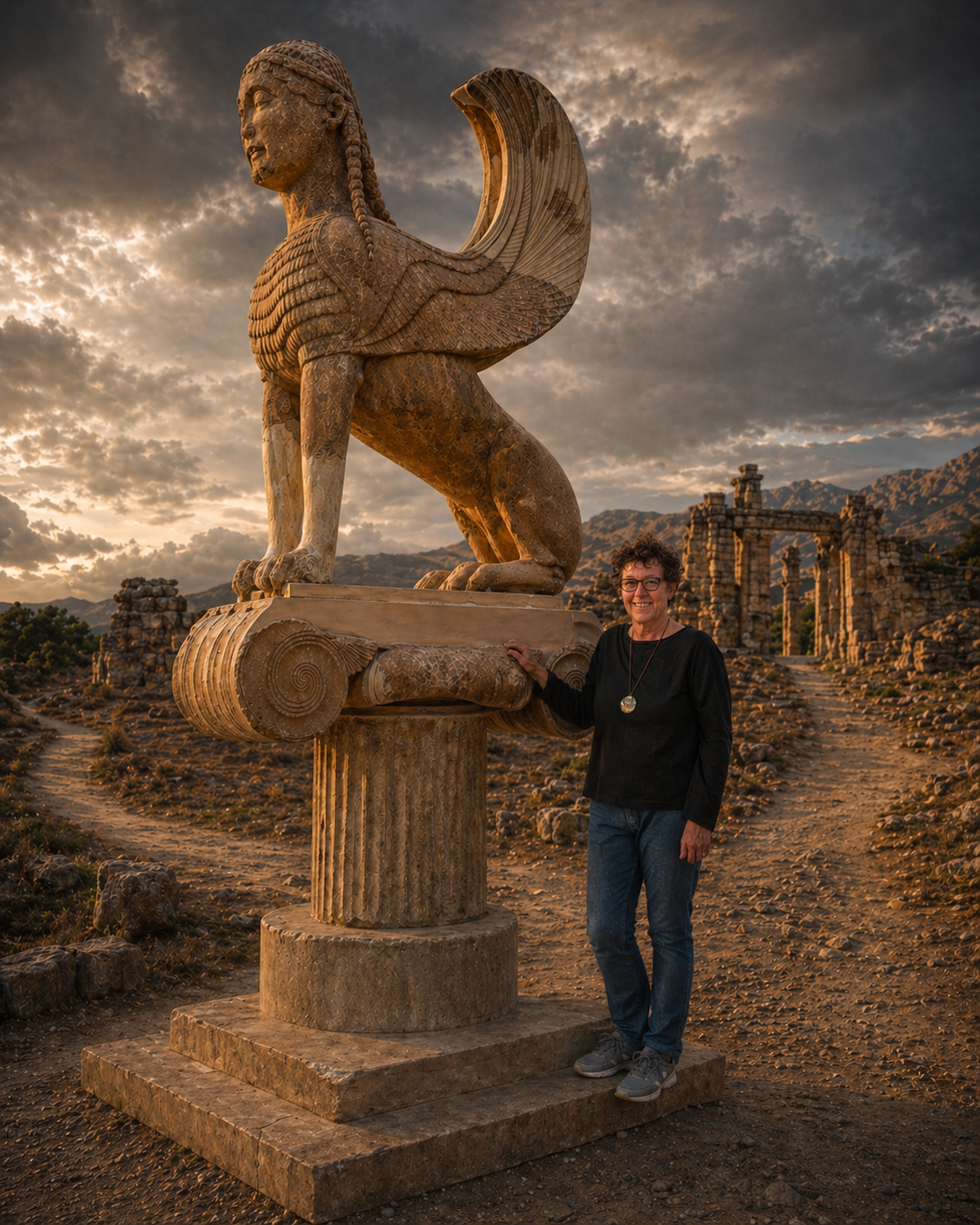
Blog 74 - Another moment when the theatre reminds me why it has always been my life.
“But until I see the words confirmed,
I will not approve of any man
who censures Oedipus, for it was clear
when that winged Sphinx went after him
he was a wise man then. We witnessed it.”
The Chorus in Sophocles’ Oedipus Rex
Getting ready for a late summer trip to New England, I have been listening to an audio recording of Ralph Waldo Emerson’s essay “History.” In it, he uses the Sphinx as an allegory for the profound riddles of human life and the inscrutable nature of time, positing that “The Sphinx must solve her own riddle.” He contends that subjective, personal experience is the sole interpreter of historical meaning, as history exists entirely within us human beings.
I have always enjoyed reading Emerson. A Transcendentalist philosopher and independent thinker, his style is somewhat oratorical, full of concise, memorable sentences that seem to open doors into profound thought. He also wrote a rather long poem called “The Sphinx,” which begins:
“The Sphinx is drowsy,
The wings are furled;
Her ear is heavy,
She broods on the world.
‘Who’ll tell me my secret,
The ages have kept?’…”
Ever since I directed and designed Oedipus Rex in 1977, I have never been able to think of the Sphinx as merely a monster from myth. In the theatre, she seems something more unsettling: a presence at the crossroads, a keeper of knowledge, a force that tests whether human beings truly know themselves.
Probably the most famous portrayal is the Great Sphinx of Giza, that enormous limestone figure symbolizing celestial power. The Egyptian Sphinx is traditionally male, while the Greek version is female. Both bear the body of a lion and a human head. In the most familiar Greek myth, the Sphinx outside Thebes asks travelers: “What moves on four feet in the morning, two feet at noon, and three feet in the evening?” Oedipus correctly answers, “Man.”
Yet even there, in Sophocles, the Sphinx feels like more than a plot device. She is not merely a creature to be defeated before the real drama begins. She hovers over the play as a dark prelude to its deepest question. Oedipus can solve the riddle of man, but not the riddle of himself.
Emerson’s Sphinx is re-imagined as a symbol of nature’s beauty and mystery. The “riddle” becomes the human soul’s perpetual, restless effort to understand itself and its place in the universe. At the end of the poem, she is called a “merry Sphinx,” who melts into purple clouds, silvers in the moon, spires into a yellow flame, flowers into blossoms red, and flows into a foaming wave. This is no devouring beast at the gates, but a shape-shifting embodiment of the world’s elusive meanings.
Oscar Wilde, in an entirely different take, also penned a poem entitled “The Sphinx,” often described as a decadent work. In it, a young student explores the conflict between overwhelming sensual desire and Christian morality. Wilde’s Sphinx, waiting in a dim corner of the room, is alluring and dangerous, a silent personification of lust and the sensual life. The narrator confronts this monstrous femme fatale and finally commands her to leave, so that he may return to his crucifix.
I have contemplated the Sphinx for years now. She is quiet and mysterious, and yet also a dominant force. She guards crossroads. She asks questions that are not easily answered. On stage, that kind of presence is especially compelling, because theatre itself lives in mystery, revelation, and recognition. The Sphinx may appear only briefly in the story of Oedipus, yet her shadow stretches over the whole tragedy.
Feminist theories, of course, offer another lens, suggesting that the creature bridges the gap between enchanting and dangerous, embodying the idea that female intelligence and power can be deeply threatening to the status quo. Unlike the usual cultural expectation that women must be nurturing or consoling, the Theban Sphinx guarded knowledge and destroyed those who failed her test. She is beautiful, terrible, and unanswerable all at once.
What fascinates me most, from a theatrical standpoint, is that in Oedipus Rex, the Sphinx scarcely needs to appear in the dialogue in order to dominate the action. She has already done her work before the play begins. Like certain great offstage figures in drama, she is felt in consequence, in memory, in the shape of what has already been set in motion.
Thebes has been delivered because Oedipus answered her question, and yet that triumph contains the seed of the tragedy to come. He solved the public riddle brilliantly, before witnesses, but the private riddle remains untouched. That is part of what gives Oedipus Rex its terrible grandeur. The hero enters as the man who once knew the answer, and leaves as the man forced to discover that he himself was the question all along.
Perhaps that is why the Sphinx has lingered in my imagination for so many years. In the theatre, crossroads are everywhere: in entrances and exits, in choices made under pressure, in moments when a character must speak or remain silent, see or refuse to see.
The Sphinx stands at just such a threshold. She is not only a monster of myth, but a guardian of difficult knowledge, asking what kind of creature a human being really is. That may be why she belongs so powerfully to the world of drama. Theatre, at its best, does not simply entertain us with answers. It confronts us with riddles, and then waits in silence while we try to recognize ourselves.