
What Happens in a Cup of Coffee: The Mystery of Ordinary Things
Blog 73 - Another moment when the theatre reminds me why it has always been my life.
This blog is taken from the April 10 entry in my book, Theatre Is My Life!
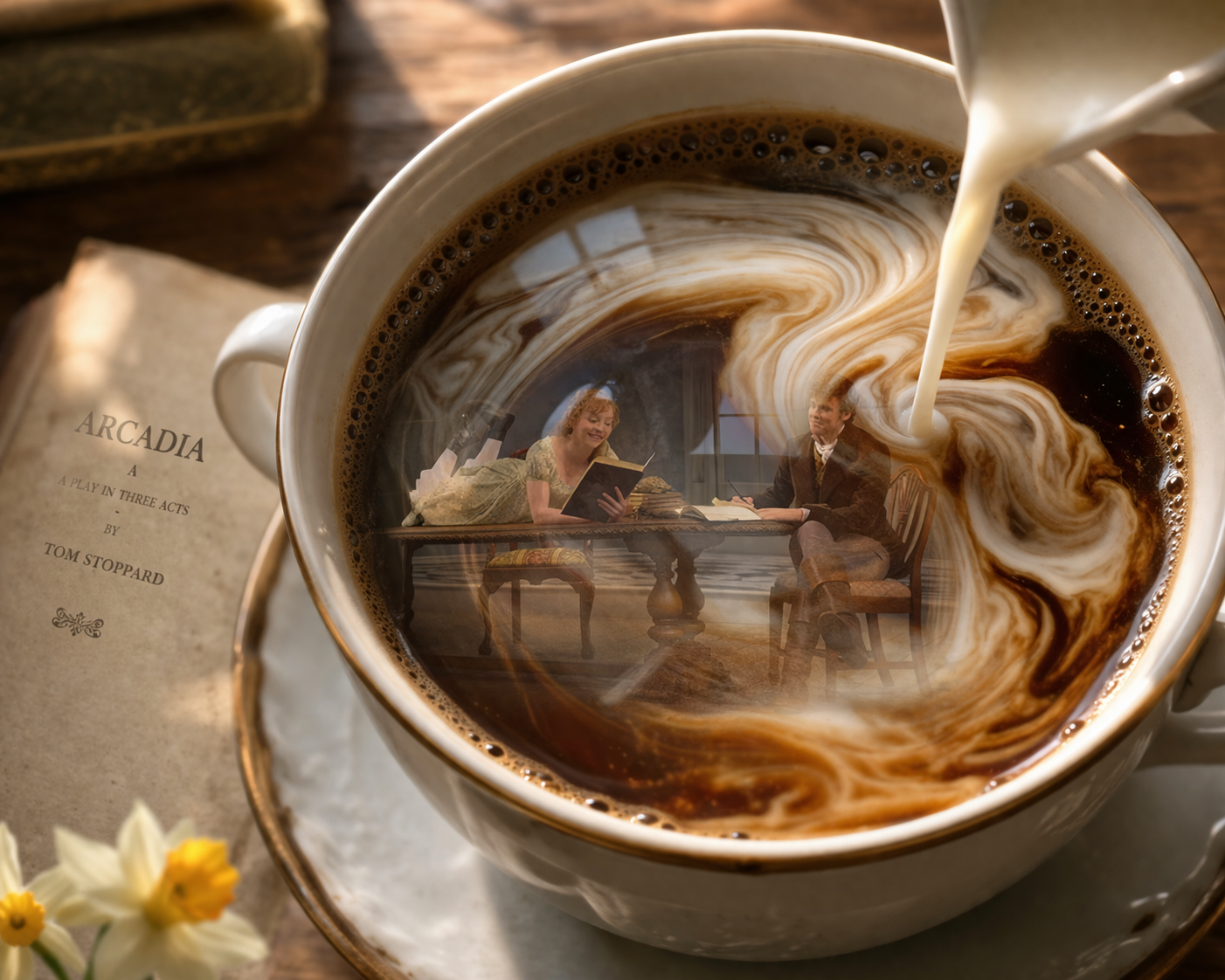
“The ordinary-sized stuff which is our lives, the things people write poetry about—clouds—daffodils—waterfalls—what happens in a cup of coffee when the cream goes in—these things are full of mystery, as mysterious to us as the heavens were to the Greeks.”
Valentine in Tom Stoppard’s Arcadia
In 2006, The Royal Institution of Great Britain named Arcadia one of the “best science books ever.” It opened at the Royal National Theatre in London on April 13, 1993. I saw a three-hour version at the Haymarket Theatre on January 4, 1995, and then went straight to a four-hour Hamlet at the Gielgud Theatre. Talk about a full day of playgoing.
A drama of mixed reviews, Arcadia is not easy to watch. It demands attention, as mathematical and scientific ideas are woven through a story that moves between 1809 and the present. Chaos theory, algorithms, landscape design, botany, determinism—all find their way into the play. What is especially delightful is how clues from the earlier period are puzzled over by the modern characters.
That idea of “ordinary life” being full of mystery has stayed with me. Most of us move through our days barely noticing the astonishing things around us.
If you want a clearer view of that wonder, spend a day with a toddler.
My son Seth and his wife Kim have a child, Teddy, who was three years old at this writing. Children don’t have to be taught that life is extraordinary—they assume it is. They marvel at blossoms that appeared overnight, stare at a yard covered in pine cones after a storm, and ask endless questions about a bird that strikes a window and then gathers itself again
There’s a wise bit of parenting advice I’ve always loved: instead of pushing children toward extraordinary lives, help them discover the beauty in ordinary things—the taste of fruit, the comfort of touch, the honesty of grief. Make the everyday come alive, and the extraordinary will follow.
And yet, I have found the opposite to be just as true.
Children teach us.
They remind us that wonder is not something we acquire—it is something we gradually set aside. Watching Teddy react to the world, I am struck by how quickly we lose that instinctive sense that life is remarkable.
One afternoon, we had piled six large black bags of pine straw in the backyard for mulching. Teddy ran up, deeply concerned: “BeBe, something is very wrong. You don’t put garbage in your backyard. It has to go by the street so the truck can pick it up.”
To him, the world still had rules that mattered—and yet, mysteries that demanded explanation.
Time with my grandchildren has made one thing clear to me: every moment is filled with something astonishing, if we are willing to see it.
Even something as simple as watching cream swirl into coffee.