
Blog 86 - Another moment when the theatre reminds me why it has always been my life.
This piece of writing is revised and updated from the October 19 entry my book, Theatre Is My Life!
“No man at all can be living for ever, and we must be satisfied.”
Maurya in JM Synge’s Riders to the Sea
When I wrote about Riders to the Sea years ago for my book Theatre Is My Life!, I understood the sea in Synge’s play as an image. Last year, in Ireland, I began to understand it as a presence.
In October of 2001, our Samford University Opera program performed Ralph Vaughan Williams’ version of Riders to the Sea, a short opera based on John Millington Synge’s play. Like so many Irish works, Riders is both gut-wrenching and achingly sad, both visceral and cerebral.
The story has the inevitability of a classic Greek tragedy, with its characters struggling against an inescapable fate. Before the story begins onstage, the elderly Maurya has already lost her husband, father-in-law, and four of her six sons to the sea. Now her son Michael is missing, and his body is soon identified after washing ashore. Before the play is over, the sea will claim her last surviving son, Bartley, as well.
Set on the Aran Islands, the play captures the brutal reality of what life was like for these isolated coastal communities where the ocean acts as an all-powerful antagonist. Synge drew the raw inspiration, the specific local dialect, and the tragic story of a drowned man from his time spent in a cottage on Inis Meáin, but he structured and finalized the manuscript over the summer of 1902 while staying in County Wicklow.
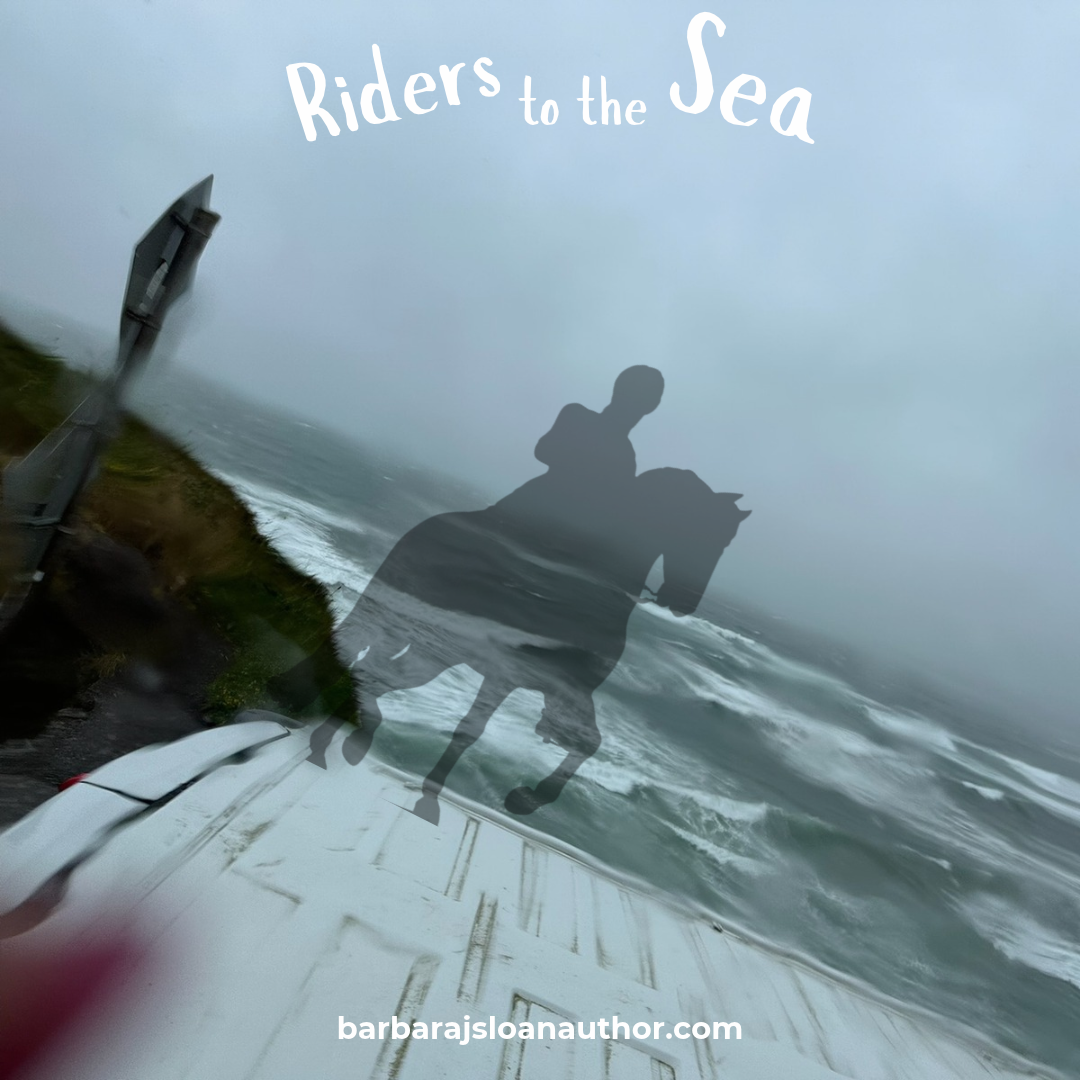
He has Maurya sense her final loss. As Bartley leaves on a horse, Maurya sees a vision of Michael's spirit riding behind him. Synge drew this haunting image from island folklore, including an account of a man's ghost seen riding a stallion.
When I originally designed the opera, Maurya’s lines felt principally about grief and resignation. But on my pilgrimage to Ireland, after standing on that rugged, wild western coast, I began to hear something else in her voice: the quiet recognition that we human beings cannot bargain with forces larger than ourselves.
We stayed on Inis Mór for three days and were steeped in the local climate, the atmosphere, and the elements. Going to and from the island, we crossed the sea in a tiny, bouncy ferry that braved huge waves, forcing our stomachs to roil and churn in unison.
That first afternoon, our pilgrim band climbed in misty fog up to the top of Dún Aonghasa, a 3,000-year-old prehistoric stone stronghold. The fort, perched precariously at the edge of a sheer rock face, looks directly down into the Atlantic Ocean. Three hundred and thirty feet below, waves crashed and thundered, beckoning our group to get close enough to the edge to see, and perhaps to fall and join the briny deep.
Next day, in a pouring shower, we rambled 40 minutes to the ruins of a monastery—which, of course, meant we had to wend our way back taking another half hour or so. But we dried our dripping locks and warmed ourselves in a cozy little café over hearty soup and local beer. And this rain-swept Aran Island terrain is the very environment that gave birth to the world of the play.
Synge did not simply invent this scenery from afar; his time on Inis Meáin deeply informed his play. I now understand, in a way I couldn't when we worked on the piece in 2001, why that landscape got into his bones and then into his text. After watching those crashing waves, I turned to my fellow pilgrims and asked, “How could he not write that play?”
This realization gives the climax of Riders a whole new meaning for me. When Bartley’s body is finally brought home, Maurya doesn't scream or break down. Instead, something in her seems irrevocably to release.
The sea has finally taken everything from her, which means it has nothing left to threaten her with. After a lifetime spent fearing its never-ending waves, she has, in a strange way, conquered them by having nothing left to lose. The ending is grim, but it grants her a quiet, heroic dignity. Her long nightmare of worrying is over.
Twenty-four years after Riders to the Sea first entered my theatrical life, I stood on Inis Mór and watched those waves relentlessly crash against the shore. They had been doing it long before Synge arrived there, long before Vaughan Williams set his words to music, and long before I designed an opera about them. They are crashing there still. Standing before something so much larger and older than ourselves, we begin to understand what Maurya meant: “...and we must be satisfied.”