
Un Bel Dì, Vedremo — Advent, Hope, And Waiting
Blog 66
“Un bel dì, vedremo, / levarsi un fil di fumo / sull'estremo / confin del mare.” (“One fine day, we’ll see / a thread of smoke rising / on the far horizon / of the sea.”) — Cio-Cio-San in Giacomo Puccini’s Madama Butterfly
Yesterday (December 22, 1858) marked the birthday of Giacomo Puccini, the Italian composer celebrated primarily for his operas. “One fine day, we’ll see…” is among the most iconic lines in the opera Madama Butterfly and appears in an aria that is at once ethereal and devastating. In it, Cio-Cio-San tries to persuade Suzuki that Pinkerton will return. She imagines a thin plume of smoke on the horizon, signaling the arrival of a distant white ship into Nagasaki harbor.
The nineteenth-century story is a classic heartbreaker. An American naval officer, Benjamin Franklin Pinkerton, marries a fifteen-year-old Japanese girl, Cio-Cio-San—Butterfly—while stationed in Japan. She gives herself fully to the marriage, severing ties with family, friends, and faith. He, however, treats the union as a temporary arrangement, never intending to bring her home to the United States. While she builds her entire future on hope, he walks away unencumbered.
If you have never seen the opera, I won’t spoil the ending. Pinkerton does return to the U.S., but Butterfly remains behind, clinging to the promise of his reappearance and singing, again and again, “One fine day, we’ll see…” Her hope is unwavering—achingly sincere—and tragically misplaced.
And here we are, in Advent, a season whose dominant theme is hope: hope for the birth of a child named Jesus, hope for light overcoming darkness, hope for a Prince of Peace who brings meaning, love, and transformation to a brutal and broken world. Advent is a time of waiting and of making space for God—perhaps as infant, perhaps as Mother or Father, perhaps as Holy Spirit. Yet in that waiting, many of us wrestle with the disquieting feeling that God is absent.
The past few months have been unsettling for me. In August, a routine mammogram led to another, more detailed one, followed by a doctor’s visit, a biopsy, and still more imaging. The biopsy showed no cancer, but there were possible precancerous cells, and an excision was recommended.
That procedure revealed a rare form of cancer: encapsulated papillary carcinoma. The original biopsy may have missed it because of the tumor’s solid-cystic nature. An MRI followed to determine margins, and then a second lumpectomy— within a month, a second major surgery by any reasonable definition.
The good news is genuinely good: this cancer is non-invasive, it was caught early, and after radiation, it is likely to be fully erased from my life. Still, in late summer, cancer—entirely uninvited—entered my life and presented a health situation I am now navigating through fall and into winter.
Once again I remind myself: we are in Advent—a season not only of Peace, Joy, and Love, but of Hope. I am thinking a great deal about spiritual readiness and active waiting: waiting for God, or perhaps more accurately, learning to recognize that God is already present. The Divine is always here, in this moment. I simply don’t always slow down enough to notice.
I feel hopeful about my physical self and my body. Cancer does not define me, though I am realistic enough to acknowledge that it is part of what I am handling this Advent and into Christmas. And so, I choose hope.
Cio-Cio-San also hoped—but she was not grounded in reality. Her love blinded her to Pinkerton’s recklessness and irresponsibility. If one is generous, he might be seen as a well-meaning man who fails to grasp the depth of Butterfly’s devotion until it is too late. Or perhaps he truly is nothing more than a repugnant charlatan.
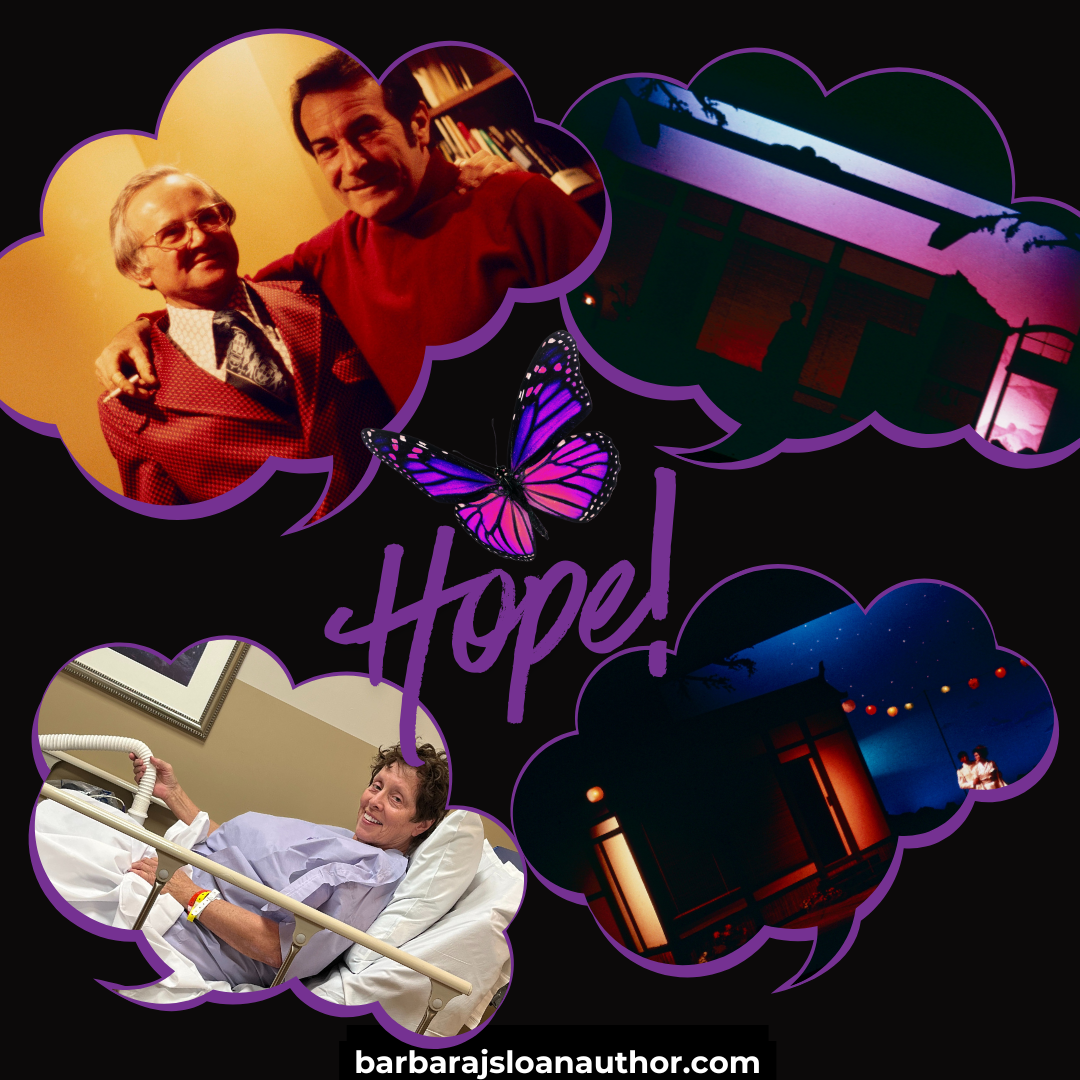
Regardless, Puccini’s music undoes me. Tears begin at the Madama Butterfly overture and continue straight through, whether I am attending a live performance or listening to my old triple-record album. Part of that response is the sheer emotional power of the music; part of it is memory—my graduate school years, when my then-husband designed the lighting for a production of Madama Butterfly.
Our beloved scene designer at the University of North Carolina at Greensboro, Andreas Nomikos, was Greek and had designed scenery for La Scala, London, and many extraordinary venues. He insisted that the end of Act I include stars in the night sky. Today that might sound simple. In the early 1970s, it was anything but.
It was spring, and no one in town carried Christmas lights. There was no internet, no quick search, no overnight shipping. The theatre storerooms came up empty. Finally, in what felt like pure theatrical sorcery, our local Sears managed to procure several sets of lights—with white wiring, no less. The result was breathtaking.
Whenever I hear the music now, all of these memories rush back. My heart has been pierced by Puccini’s Madama Butterfly—by its beauty, its cruelty, and its aching hope. I listened again just yesterday, and I wept. From now on, this Advent—this season of waiting, diagnosis, treatment, and hope—will also be woven into that music whenever I hear it play. “One fine day, we’ll see” the meaning in all this, and it will all be good.