
A Blanket, a Prop, and the Body’s Need for Safety
A prop becomes a sanctuary
Blog 68
What Theatre Knows About Security Blankets
In “My Blanket and Me” from You're a Good Man, Charlie Brown, Linus sings about his permanent childhood token as a “cozy sanctuary.” (Listen to the work online or from your library!)
Linus’s “My Blanket and Me” in Clark Gesner’s You're a Good Man, Charlie Brown
If you read my blogs or my book, Theatre Is My Life!, you probably remember that I taught theatre at Samford University for 25 years. So most of my essays begin with a play quote and then expand into a personal reflection on the lines.
You might wonder what Linus’s blanket has to do with acting, pain, and the body’s need for safety. If you have seen You’re a Good Man, Charlie Brown, or if you are a Peanuts fan, you know that Linus’s blanket is central to his character.
In the musical, it features prominently in his solo song, “My Blanket and Me,” where he sings—thumb firmly in mouth—about its “cozy comfort.” In a brief attempt at self-reliance, he throws it on the floor and tries to move on without it. Lucy, with help from Sally, mocks her baby brother mercilessly.
Despite the ridicule, Linus soon races back to his lovey and scoops it up, proving its indispensability. He even daydreams a blanket fantasy—one in which everyone can live happily with their own coverlet compulsions intact. Linus’s blanket is a theatrical object, as well as a character device.
A blanket is never just a blanket. Many children get attached to coverlets, because they provide security, comfort, and familiarity as children move from total dependence to independence. When very young, my daughter Elin carried a raggedy but very velvety cloth diaper around with her as she grew sleepy, and she would begin to suck her two middle fingers. Later, my mother embroidered a supple dish towel to replace the diaper. She finally gave up the practice — but not until age six.
Right now, my granddaughter Lucy sucks her thumb and twists a curl of hair when she’s drowsy. Early on, a blanket, a stuffed animal, doll, or even hair’s touch brings the feeling of the parents’ presence even when they're gone. Most mammals have a physiological bonding response to warm, soft, furry objects. Researchers say the tactile comfort and repetitive motion of rubbing a blanket or “stuffy” releases oxytocin—the feel-good hormone—providing calming sensory input. In other words, Linus was onto something.
As a costume designer in my professional work, I watched many of my student actors get emotionally attached to specific costume pieces, feeling as if their shirt or dress were tangible parts of their character’s identity. Wearing the item gave them a safe, serene feeling. And some negotiated keeping their beloved garment. (Well, then, there were also the Freshmen boys who were so mortified to go on stage in tights that they would have loved to have burned them and never seen them again!)
Costumes and personal props are extensions of a theatrical character, and if the production is a special experience, I can see why actors want to take them home. Certain objects contain sentimental value, deeply tied to the character and the actor's portrayal. And maybe the totem will charm the rest of their lives as well.
And, actors sometimes have lucky superstitious items or personal talismans to ward off “jinxes” and ensure a successful performance — security blankets of sorts. It might be a special necklace, providential socks, or a fortuitous hair barrette. Fred Astaire used a specific pair of lucky shoes when he felt stuck during dance rehearsals. And Heidi Klum is said to carry a small bag containing her children’s lost teeth to encourage success.
In the spring of 1987 at Samford, we produced You're a Good Man, Charlie Brown, and the department just did a revival in October of 2024. I don’t remember if our Linus got attached to his blanket and kept it after the performance. Universities usually have so little costume and prop storage, I never minded if a few hankies or neckties, medieval banners or ruffs disappeared.
In October of 2022, my fiancé Roger fell over a curb at the Gulf Island National Seashore near Navarre, Florida. He was fine. For a while. After a few weeks, his back began to hurt, and through early Winter, the pain persisted. When he got home after a long driving trip, he visited his doctor who thought he had bursitis in his hip.
As Spring progressed, he had trouble sleeping, had to stand at plays or music events, and was physically miserable a lot of the time. An orthopedic doctor said an X-ray and MRI showed a torn superior and bulging disk, but no remedy seemed to help much. A friend introduced him to Deep Blue ointment, which alleviated some pain — as did Vodka.
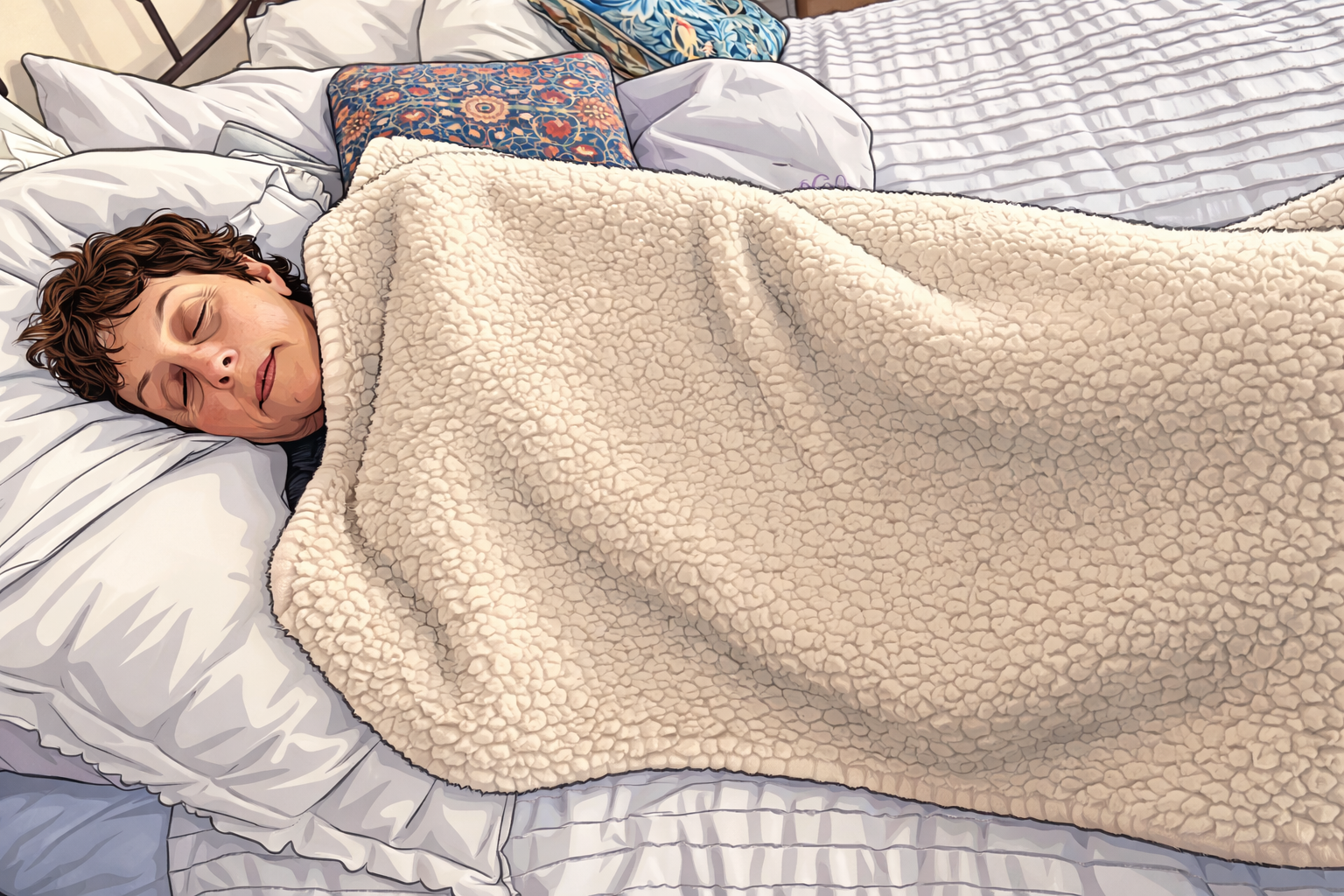
After sitting up sleeping at night in the Great Hall for several months, Roger greatly desired a good night of sleep in the bed. One night, he tried lying on top of the comforter covered up by a lamb-like wooly throw blanket. He slept all night! And the next night, and the next. Miraculously — as a child who reacts to the soft texture of a blanket, thus releasing oxytocin — his symptoms began to gradually dwindle. I called it the “Magic Blankey,” and I was glad it helped. But I was a little skeptical.
A few weeks ago, I began to have some intense knee pain. I could still go on our 2-mile walks every day, but the throbbing was sometimes excruciating at night and I slept very poorly. I tried tape, wrap, brace, heat, ice, creams, and more to very little avail. One night I decided to try Magic Blankey, which, by the way, you have to use with no sheets or covers between you and it.
Unbelievably, I snoozed for seven hours with minimal waking. That, and a visit to my myofascia massage therapist and some neuroplastic pain work, have just about chased the knee pain away. And so, I concur with Linus: a blanket really can be a “cozy sanctuary.” It broke the pain cycle long enough for me to believe this agony wasn’t forever. I think I’ll go curl up with it right now—no ridicule required.