
We Must Try to Love One Another: Reflections on motherhood, memory, and the lessons theatre teaches us.
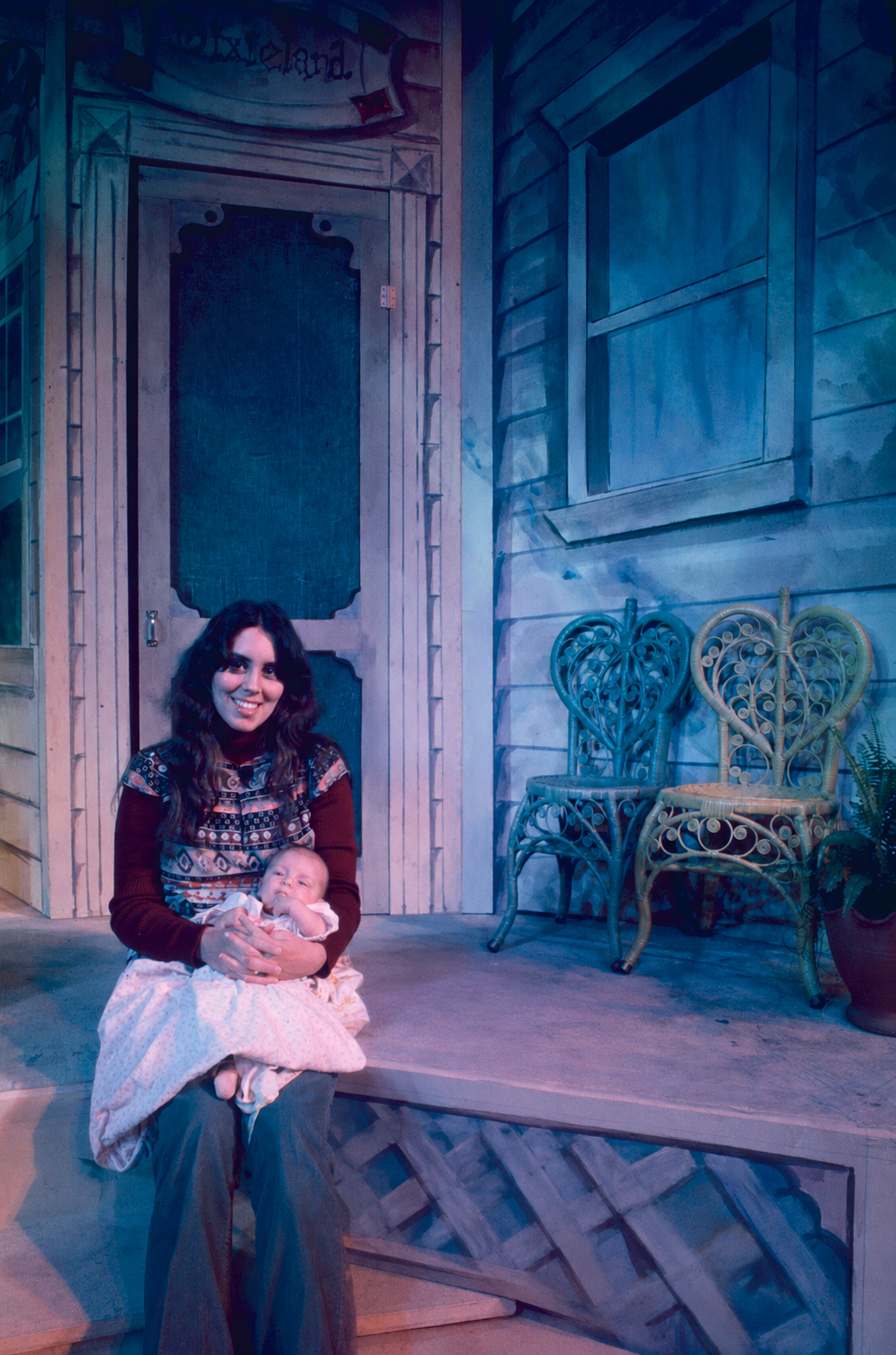
Here I am holding my infant daughter Elin on the set for Look Homeward, Angel
Blog 75 - Another moment when the theatre reminds me why it has always been my life.
This blog comes from the May 12 entry in my book, Theatre Is My Life! It was originally written in 2014, and has been updated a bit.
May 12
“(Holding him.) Poor child... poor child... poor child. (Huskily, faintly.) We must try to love one another. (Finally Eugene moves from her, picks up the valise, as the lights start dimming, holding a spot on her. Eliza seems to recede in the distance as into his memory.) Now for Heaven’s sake, spruce up, boy, spruce up! Throw your shoulders back! And smile, look pleasant! Let them know up there that you are somebody!”
Eliza Gant in Ketti Frings’s Look Homeward, Angel adapted from the Thomas Wolfe novel of the same name
Just two days ago was Mother’s Day, so Happy Day, Mothers! This year marks my first Mother’s Day to have no mom with whom to celebrate, so not only do I feel like a motherless child, I am a motherless child, even at sixty-four.
Yesterday, our priest read a wonderful all-inclusive prayer for Mother’s Day. It included blessings for women with their own birth children, women who wished for a child but were barren or who had miscarried, for women who adopted, for women who had lost children, for children who had strong relationships with their maternal parent, for children who had broken or non-existent ties, for children who had been mothered by men and for men who had acted as mothers to others, for single mothers, for poor and incarcerated mothers, for mothers forgotten by their children, for children forgotten by their mothers.
Eliza Gant is a strong-willed mother in Ketti Frings’s Look Homeward, Angel and in the original, largely autobiographical and coming-of-age Thomas Wolfe novel. Maybe she shouldn’t have even had children. A shrewd businesswoman, Eliza runs a boarding house called The Dixieland. Obsessed with material security, she struggles to form intimate bonds within her family. W.O. Gant, an alcoholic stonecutter, is dejected by his failures and unable to stand up to his wife.
Eugene Gant (aka Thomas Wolfe) has finally decided to leave the madhouse of theatrical characters, both in his family and among the eccentric boarders. Eliza holds him and says, huskily and faintly, “Poor child... poor child... poor child. We must try to love one another.” But as the novel states so poignantly, “the terrible and beautiful sentence, the last, the final wisdom that the earth can give, is remembered at the end, is spoken too late, wearily.” Wow. What we can learn from plays and novels!
We produced Look Homeward, Angel in the fall of 1976 when my daughter Elin was a two-month-old babe in arms. I didn’t like cold Eliza very much, and vowed to be as little like her as I possibly could be. Yet her fierce determination reminded me of my hardworking mother-in-law, who also endured an unreliable husband while raising three boys largely on her own. Despite the hardships Eliza had to overcome, she seemed, to me, to be recalcitrant, bullheaded, and headstrong — not my picture of loving, forgiving, warmhearted motherhood, not my image of the kind of mother I hoped to be.
Looking back now, I know in mothering my children, as the Book of Common Prayer says, I left undone things which I ought to have done; and I did those things which I ought not to have done. Still, I have great relationships with my adult children who have been free to make their own choices, find their own dreams, build their own futures with all the support I could possibly give. In this year’s Mother’s Day cards, Elin thanked me for being a strong role model and loving mother, and Seth wrote that I have always been “home” to him.