
Every Time the Play Is Performed, Someone must become Job
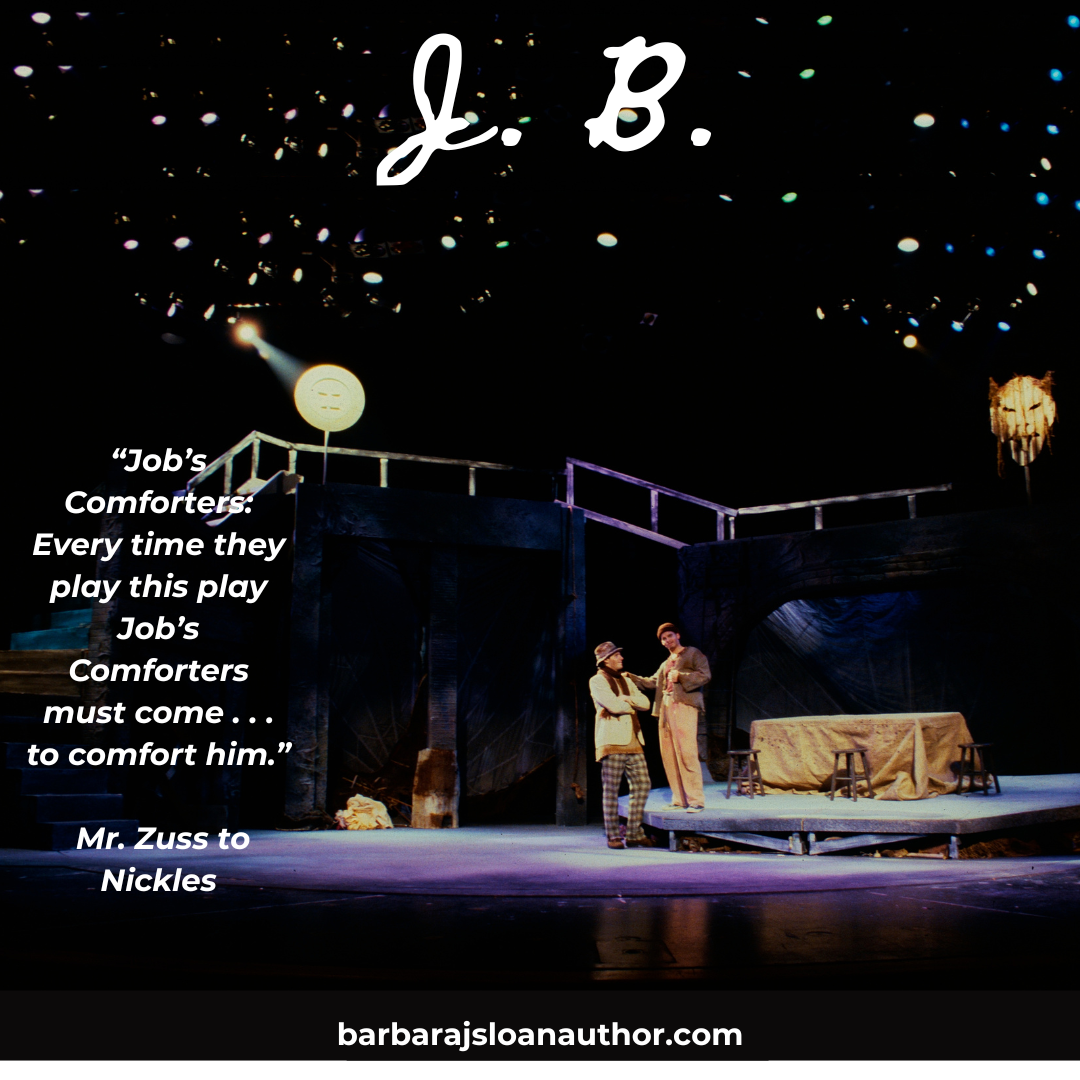
Samford University Theatre’s JB in 1995
Blog 71 - Another moment when the theatre reminds me why it has always been my life.
“Job’s Comforters: Every time they play this play Job’s Comforters must come . . . to comfort him.”
Mr. Zuss to Nickles in Archibald MacLeish’s JB
We are now in the midst of Lent, so what more appropriate play from which to quote than JB, Archibald MacLeish’s retelling of the story of Job?
“Every time they play this play...” I love the theatricality of the play within the play of JB. In it, Mr. Zuss and Nickles once again, as if having done so thousands upon thousands of times before, pick up their masks and play God and Satan.
Samford University Theatre produced this play in the spring of 1995 and I designed the costumes. The play suggests that the drama of Job is not a single performance in ancient scripture but a role humanity keeps rehearsing.
And not only Job: we all impersonate God and Satan, don’t we? Sometimes every day. And we take on the role of Job, too. Job is Everyman, and I am Everyman as well. When Samford produced this play, I had myself been through a rough couple of years, so I could feel a tiny measure of the anguish of this JB character.
The Job of the Old Testament owns lots of camels, sheep, and oxen and is blessed with wealth and a large family. He praises God for his lot in life. MacLeish’s JB is an affluent New York banker who believes God has given him success as a reward for his faithfulness. Both Job and JB lose everything and are reduced to the dung pit, the ash heap of life.
Neither man is prepared for what happens to him, and both question God and cry out for justice, for understanding, for meaning from the universe. MacLeish himself wrote, “And it is in those repeated cries of his that we hear most clearly our own voices. For our age is an age haunted and driven by a need to know. Not only is our science full of it but our arts also. And it is here, or so it seems to me, that our story and the story of Job come closest to each other.”
In the biblical version of the tale, Job is visited by three friends who want to console him, but they deeply believe that Job’s suffering is retribution for his sins. They counsel him to confess what he has done wrong, and seek God’s compassion. Three friends also call upon JB in the play, but in the modern version, the Comforters epitomize Science, Religion, and History. When each offers a different explanation for his suffering, JB sends them away in disgust.
Turning to God for an explanation, JB wants to know: where is justice and why do bad things happen to good people? The God-like Mr. Zuss asks JB who he is to ask such a question of the Creator of all? He promises that if JB will abhor himself and repent, he can save himself and go back to his old life. Like Job, he had always heard of God, but now he has seen him, “the mystery of the universe, beauty beyond the feel of fingers...” At first, JB feels remorse, but then, he asks, “Repent? For crying out? For suffering?... Must my breath, my breathing, be forgiven?”
JB doesn’t want to accept the idea that humans will never know why we suffer and why God is mute on the matter. “He answered me like the stillness of a star that silences us asking... We are and that is all our answer. We are and what we are can suffer.”
MacLeish does not elucidate the reason for human pain any more than the author of Job does. He simply portrays a human grappling for the meaning of life, asking the hard questions. “Why suffering? Why me? Why life?” I have to find the answers myself, as I explore the role of Job. Job is Everyman. And every time the play is performed, I discover that I am standing somewhere in that ash heap — where I am Everyman, too.